
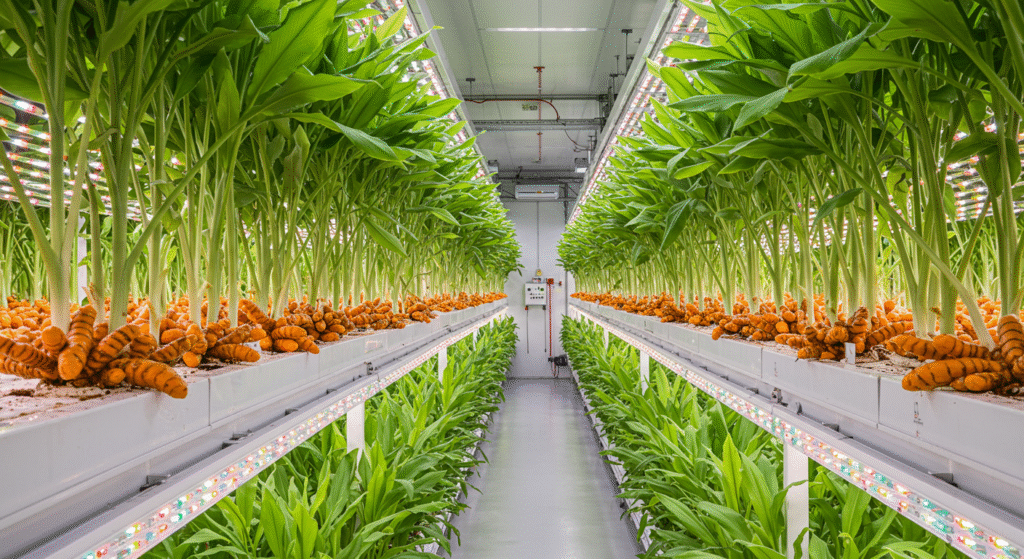
In an era defined by increasing demand for sustainable food production and a growing awareness of health-benefiting superfoods, a revolutionary agricultural method is taking root: commercial vertical turmeric farming. As traditional farming grapples with land scarcity, water shortages, and climate unpredictability, vertical farming offers a potent solution, and turmeric, with its high market value and specific growth requirements, is proving to be an ideal candidate for this innovative approach. This deep dive explores why commercial vertical turmeric farming is not just a passing fad but the next big trend poised to reshape the agricultural landscape. Greentechhydrofarming is the expert hydroponic consultants deliver advanced, sustainable soil-less farming solutions for maximum yield.
Vertical farming, the practice of growing crops in vertically stacked layers in a controlled environment, has moved from a niche concept to a mainstream solution for a variety of crops. It addresses critical challenges faced by conventional agriculture, such as inefficient land use, reliance on seasonal weather, and extensive water consumption. While leafy greens and herbs have dominated the vertical farming scene, root crops like turmeric are emerging as highly profitable ventures, offering year-round harvests of premium quality produce.With cutting-edge hydroponic systems and tailored guidance, GreentechHydroFarming helps businesses and growers achieve consistent, high-quality production.
Turmeric (Curcuma longa), a revered spice and medicinal rhizome, is known for its active compound, curcumin, which boasts powerful anti-inflammatory and antioxidant properties. Its traditional cultivation is often lengthy, weather-dependent, and susceptible to soil-borne diseases. However, under controlled conditions, turmeric thrives:
We’re here to design and deliver the best hydroponic solutions—contact us today to start your journey toward sustainable, high-yield farming.
One of the most compelling advantages of commercial vertical turmeric farming is its unparalleled space efficiency. By growing crops in multiple layers indoors, farmers can achieve significantly higher yields per square foot compared to traditional field farming. This high-density cultivation translates directly into greater profitability, especially in urban or peri-urban areas where land is expensive and scarce.
Vertical farming systems, particularly those employing hydroponics or aeroponics, use up to 95% less water than conventional agriculture. Water is recirculated, and evaporation is minimized in the enclosed environment. Furthermore, nutrient solutions are precisely delivered to the plants, reducing waste and ensuring optimal absorption.
Operating indoors, a vertical turmeric farm is entirely independent of external weather conditions. This means no crop losses due to droughts, floods, frosts, or pests. Farmers can ensure consistent, year-round production, meeting market demands reliably and planning harvests with precision, regardless of the season.
The controlled environment allows for the cultivation of turmeric with enhanced quality. Factors like light spectrum, nutrient composition, and growth duration can be fine-tuned to potentially increase curcumin content, color vibrancy, and overall rhizome size. Moreover, the absence of soil-borne pathogens and the reduced need for pesticides result in cleaner, often organic-grade turmeric.
By establishing vertical farms closer to consumption centers, transport distances are drastically cut, leading to a significant reduction in fuel consumption and associated carbon emissions. This urban or peri-urban farming model also provides fresh, local produce, enhancing food security and reducing reliance on long supply chains.
Embarking on a commercial vertical turmeric farming venture requires careful planning and investment in specialized technology. The initial setup involves:
While the initial capital expenditure for a vertical farm can be substantial, the long-term returns are highly attractive. Factors like maximized yields, reduced resource consumption, premium product pricing, and year-round production contribute to a strong return on investment (ROI). Feasibility studies and detailed business plans are crucial for success.
The complexity of designing, installing, and managing a high-tech vertical farm necessitates specialized knowledge. Partnering with experts can be invaluable. If you’re considering entering this exciting field, exploring comprehensive services for commercial vertical farming setup can provide the guidance and technology needed to build a successful operation.
The global turmeric market is projected to continue its upward trajectory, driven by increasing consumer awareness of natural health remedies, its application in functional foods, and its enduring popularity in culinary arts. Commercial vertical turmeric farming is perfectly positioned to capitalize on this demand by offering a premium, sustainably produced product that meets stringent quality standards. As the world increasingly seeks efficient, resilient, and environmentally friendly agricultural solutions, vertical farming for turmeric stands out as a pioneering and profitable opportunity.
Commercial vertical turmeric farming is more than just a novel concept; it represents a significant leap forward in sustainable and profitable agriculture. It addresses the pressing challenges of our time while opening doors to unparalleled efficiency, quality, and environmental stewardship. For visionary entrepreneurs and agricultural investors, embracing this trend offers a chance to cultivate a highly sought-after superfood, ensure food security, and build a resilient business model for the future. The next big wave in farming is here, and it’s growing vertically.
Connect with GreentechHydroFarming to get expert guidance from our professional hydroponic consultants and boost your farming efficiency.
Yes, commercial vertical turmeric farming can be highly profitable due to maximized yields in a small footprint, reduced resource consumption (water, land), year-round production, and the ability to produce premium quality turmeric with potentially higher curcumin content, fetching better market prices. However, it requires significant initial investment and expert management.
Significantly less land than traditional farming. A vertical farm can grow the equivalent of acres of field-grown turmeric in a fraction of the ground footprint, as cultivation occurs in multiple stacked layers. The exact footprint depends on the desired output capacity.
Key benefits include maximized yield per square foot, up to 95% less water usage, year-round production independent of climate, superior product quality (potentially higher curcumin), reduced need for pesticides, lower carbon footprint due to local production, and protection from pests and diseases.
Yes, turmeric can be successfully grown using hydroponic systems. This soilless cultivation method allows for precise control over nutrient delivery, water usage, and root environment, often leading to faster growth and healthier rhizome development compared to traditional soil-based methods.
While specific curcumin content can vary based on cultivar and growing conditions, vertical farming allows for precise environmental control (lighting, nutrients, temperature). This controlled environment can be optimized to potentially enhance the production of active compounds like curcumin, often leading to higher or more consistent levels compared to field-grown turmeric, although more research is ongoing in this area.